Liberté

Yesterday was been a strange day; after watching a movie that took place in Paris (La Belle Personne), news started rolling in what was going on in the real, current Paris.

My heart goes out to the people in Paris and France in general for this dreadful day. What drives people to try and impose a freedom-less world is difficult to grasp. Frustration, anger, jealousy perhaps. An overflow of testosterone, a desire for power by destroying one’s self (both literally and figuratively, paradoxically). We can never surrender to such a stance, since that means life is no longer worth living. And with all that brain power that all of us have, surely it’s not difficult to figure out that this is not the road to any kind of viable society. The only way forward is to prevail. I always thought I’d see a war in my lifetime, I just didn’t imagine it to be like this.

Tour Eiffel

High speed sync (HSS) with ordinary flashes

Tags

,

I have a home studio which is not small, but also not that large. I own a couple of flash heads, ranging from 150Ws to 400Ws. My most used flashes are Linkstar ones of 250Ws and 400Ws.
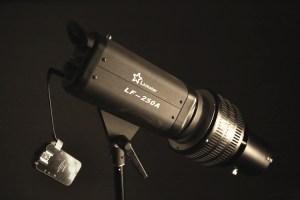
LF-400 with Yongnuo YN-622C

Linkstar LF-250 with Yongnuo YN-622C

I shoot mostly portraits and like low diaphragm settings like f/2.8 (or lower with fixed focal length lenses) to get depth of focus effects where the eyes are sharp, but sharpness quickly falls off when you look at hair or the body. That effect has always been one of my big incentives to switch from simple small cameras to larger, fullframe camera bodies. Currently my main body is a Canon EOS 6D, which features a fullframe sensor, and lots of light sensitivity.

The flashes in my studio generate quite a bit of light, and especially when balancing multiple lights it’s easy to get more light than really desired to stay low enough to be able to use something like f/2.8, even if you lower the ISO to 50. Also, as 100 ISO is probably the ‘native’ mode for the sensor, I like to stay up there. But what to do with the abundance of light?

When I started out, I used cable to flash. I quickly turned to wireless triggers, a Cactus v5 set. The maximum (or should I say minimum) exposure time is around 1/180s for Canon upto 1/250s for Nikon, depending on the model a bit.

To keep light under control, I then turned to ND-filters. A stop of 3 or 4 can give you a lot of control in this small environment, but the downside is that your viewer also gets darker, and your automatic focus suffers to the same degree. Fortunately the 6D has excellent focusing skills, but still, it was less than perfect.

Then lately I discovered the Yongnuo YN-622C E-TTL wireless remote triggers. The ‘C’ stands for Canon btw, but there is a version for Nikon as well. These talk TTL to the Canon body, which means you suddenly get HSS – High Speed Sync. In layman’s terms this means that you can finally dive under those 1/180s times.
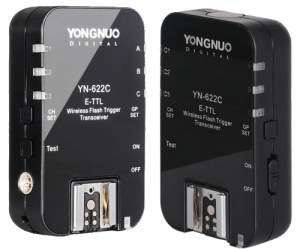
Wireless triggers capable of talking E-TTL to the body

Wireless triggers capable of talking E-TTL to the body

I really discovered them when buying an outdoor kit; a Jinbei Discovery DC1200 battery flash unit. To get these to do HSS, you need to connect them with a small cable, instead of using the triggers supplied by Jinbei. If you use the built-in remote trigger, you can’t do High Speed Sync. It took a while for me to figure that out.

After that I noticed that the same method works with my fairly standard Linkstar LF-250 and LF-400 flashes. I could get rid of the ND filters (which will only give you less sharpness if they get dirty) and just use 1/4000s if I wanted to (the 6D doesn’t go any quicker than that).

So now the 400Ws power is no longer an issue, and I can shoot upto f/1.4 without problems in my 5x5m studio.

Darkness falls across the studio

Tags

, ,

In my studio, I have a fairly standard Manfrotto 3-bar background paper setup, where I can easily roll on or off three different colors of background paper.

Throughout the years, I’ve moved from using colored backgrounds, such as red and blue, towards gray tones. I ended up a month or so ago with black, white and a light gray. Now, I’ve moved out the white background. Why? It seems I often find the white background unnecessarily white, and can use the slightly darker gray as well.

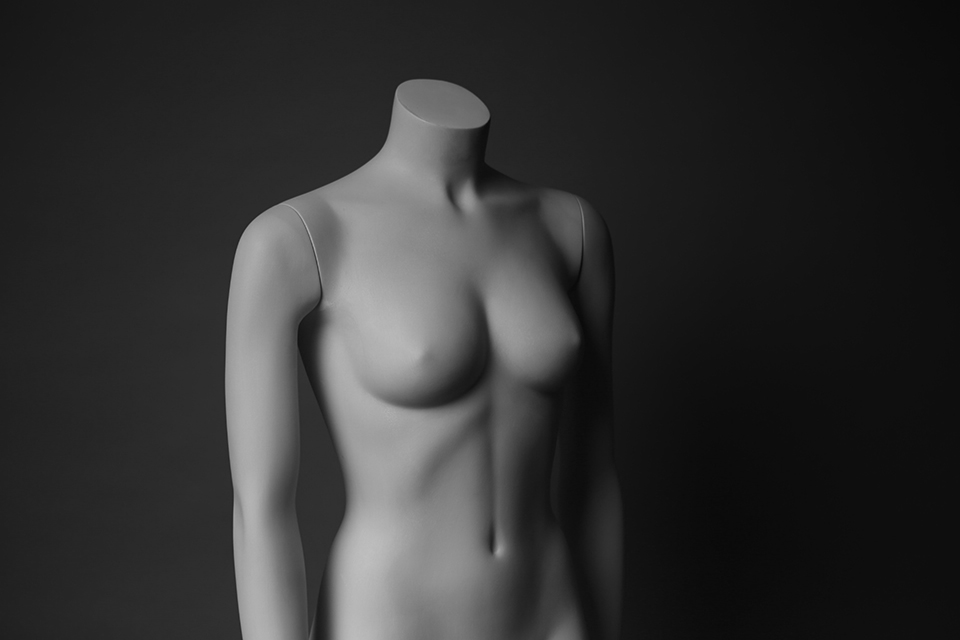
Below are three shots, starring my trusty bodypainted bust (thanks to Belinda for the bodypaint, so it actually has a skintone color instead of being flashing white!). The top color is the light gray (Savage Slate Gray), the bottom color is Savage Smoke Gray.

IMG_7240

Although it still looks kind of dark, I noticed while shooting with actual people and actual shots that the skintone of people quite nearly matched that of the background (in light areas of skintone). I often like the background to be darker though, so that the entire body stands out. With the light background, I can simulate white now, since it’s already quite light. With the darker Smoke Gray, I can go a step further, making moody images without going full-on with a black background paper.

Here is a shot with the light Slate Gray. Note that here things appear a little darker than with actual human subjects (unfortunately).

IMG_7241

And a shot with the darker gray, Smoke Gray. This gives more contrast, without really going towards black. I know, you can get black by moving the subject away from the background, but my studio is not that large and I like a bit of shadow to get a bit of 3D feel.

IMG_7242

I should redo this test with an actual model probably. But for now, I have the three colors light gray (slate), smoke gray and black hanging. Looking forward to the next shoot to try it out!

Sunny Hat

Tags

, ,

It’s always nice to do some experimentation at the end of a shoot (if it’s not already an entire evening of experimentation).

This photo was taken with a flash very nearby Annemiek’s hat (too close in hindsight, further away would mean sharper shadows on her face probably). There’s another flash slightly giving light at the right side of the camera.

After that it was a matter of correcting the light balance here and there in Photoshop, and adding some contrast, plus a bit of clarity on the side. I love the end result.

It’s just that there’s hardly any place anymore for the logo. 😉

Sunny Hat